



MBA: Multimodal Benchmark and Agents for
Real-World Business Ideation

1KAIST AI
Preprint
Corresponding author.

Abstract

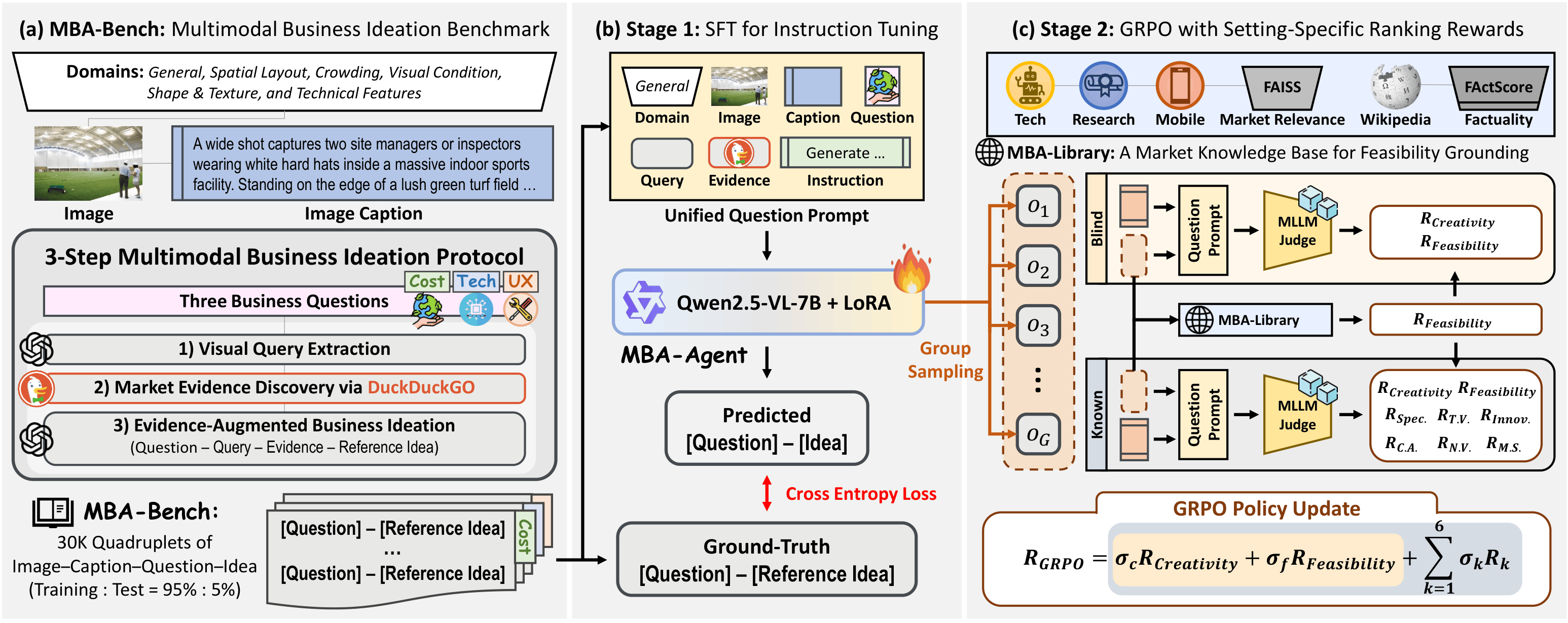
Agentic systems powered by large language models (LLMs) have opened new opportunities for business ideation. Yet existing approaches remain confined to a text-only paradigm, despite the inherently multimodal nature of real-world contexts. We thus introduce MBA-Bench, the first multimodal benchmark for training and evaluating business ideation agents, comprising 30K samples across six domains, each domain characterized by distinct visual cues not fully conveyed by text alone. Concretely, we automatically caption images and employ GPT-4o to generate five reference ideas for each of three business questions through retrieval query generation, market evidence retrieval, and evidence-augmented synthesis. Following prior work, we evaluate agents across six business-oriented criteria using MLLM-as-a-Judge. To consider settings where criteria are hidden or disclosed, we present MBA-b and MBA-k for blind and known, respectively. We train both with two novel reward objectives---creativity and feasibility---while MBA-k further optimizes the six disclosed criteria for eight in total. Both are trained via LoRA-based supervised fine-tuning followed by group relative policy optimization with these setting-specific rewards. For extensive experiments on MBA-Bench, we set up two baselines accommodating either captions only or multimodal inputs, with the latter nearing closed-source performance on several metrics. MBA-b and MBA-k outperform caption baselines by 53.6% and 67.3%, and multimodal baselines by 16.9% and 27.4%, respectively.
Overview

MBA overview

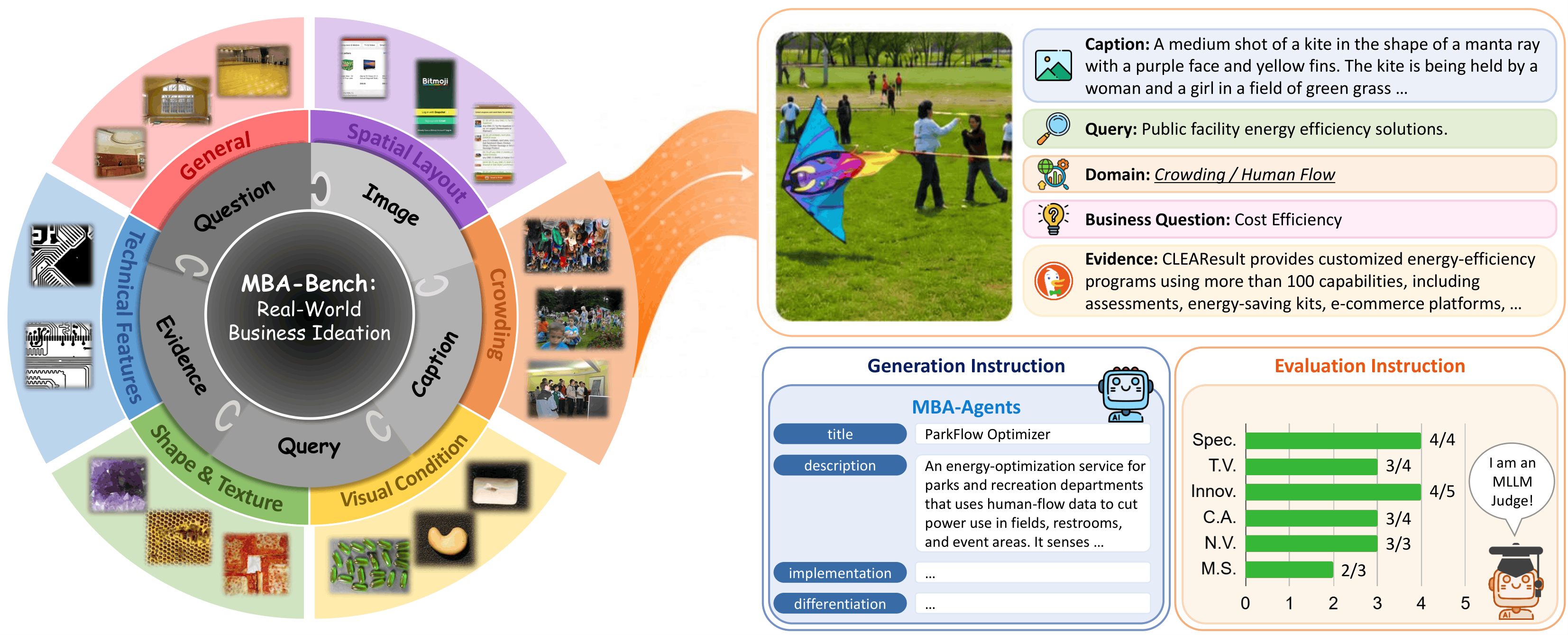
MBA reframes business ideation as a multimodal agentic task. Instead of relying only on patent text or manually written prompts, MBA-Bench starts from real-world images, captions, domain labels, business questions, and retrieved market evidence. The resulting benchmark evaluates whether an agent can generate ideas that are specific, technically valid, innovative, competitively differentiated, aligned with user needs, and scalable in market size.

30K
image–caption–question–idea samples
6
visually grounded domains
8
training / evaluation reward objectives
2
MBA agents: blind and known
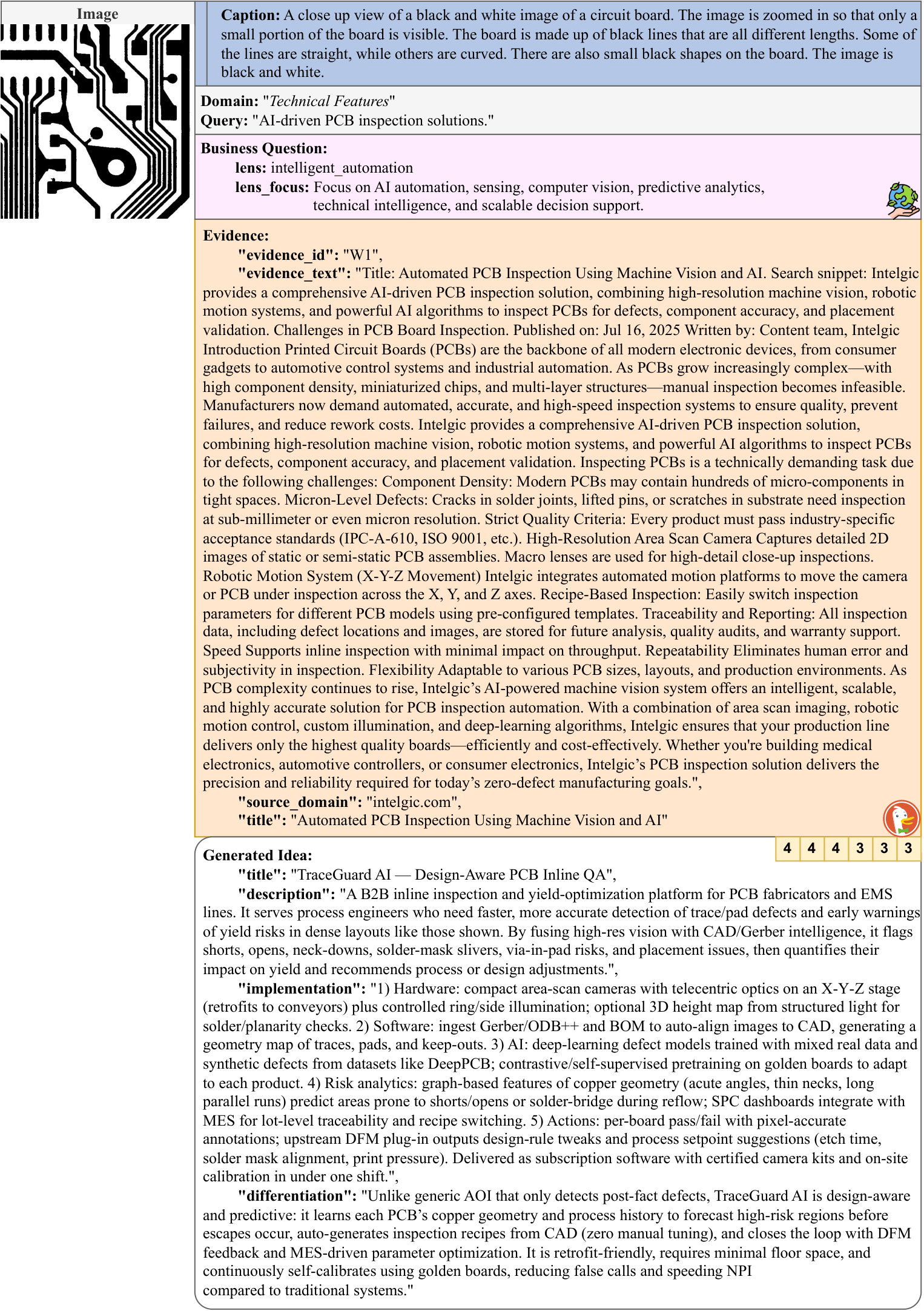
General Spatial Layout Crowding Visual Condition Shape & Texture Technical Features

Why Multimodal Business Ideation?

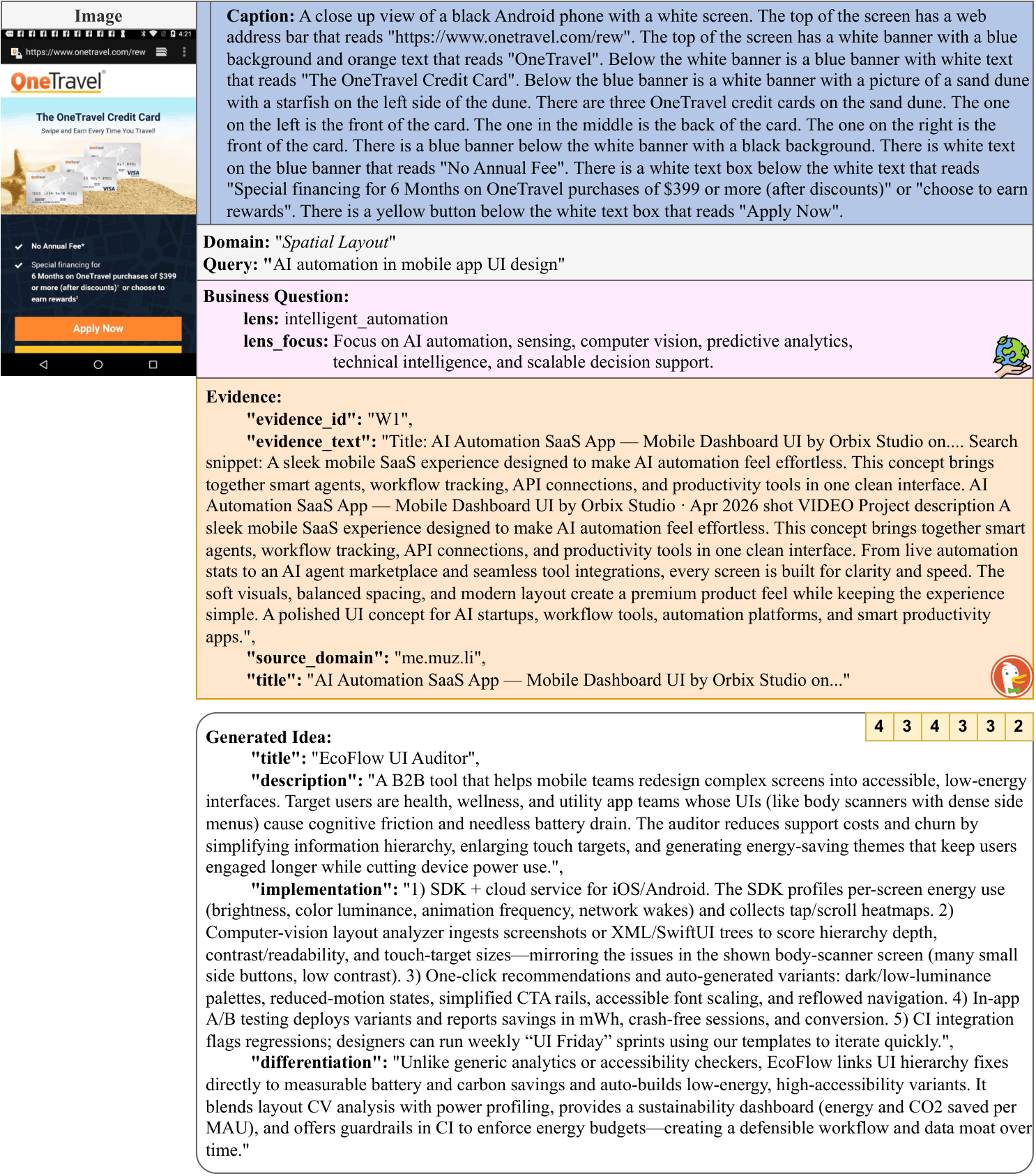
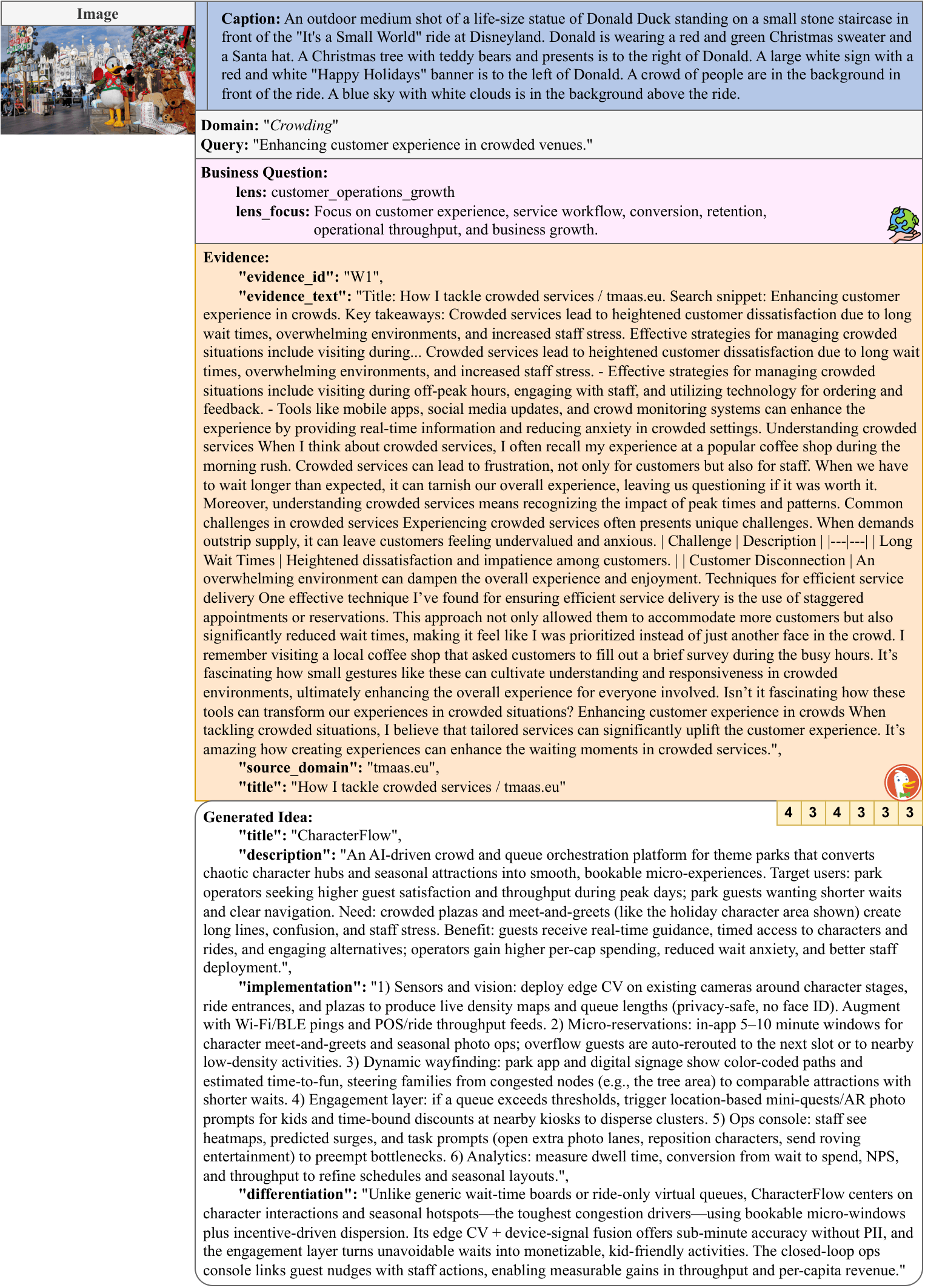
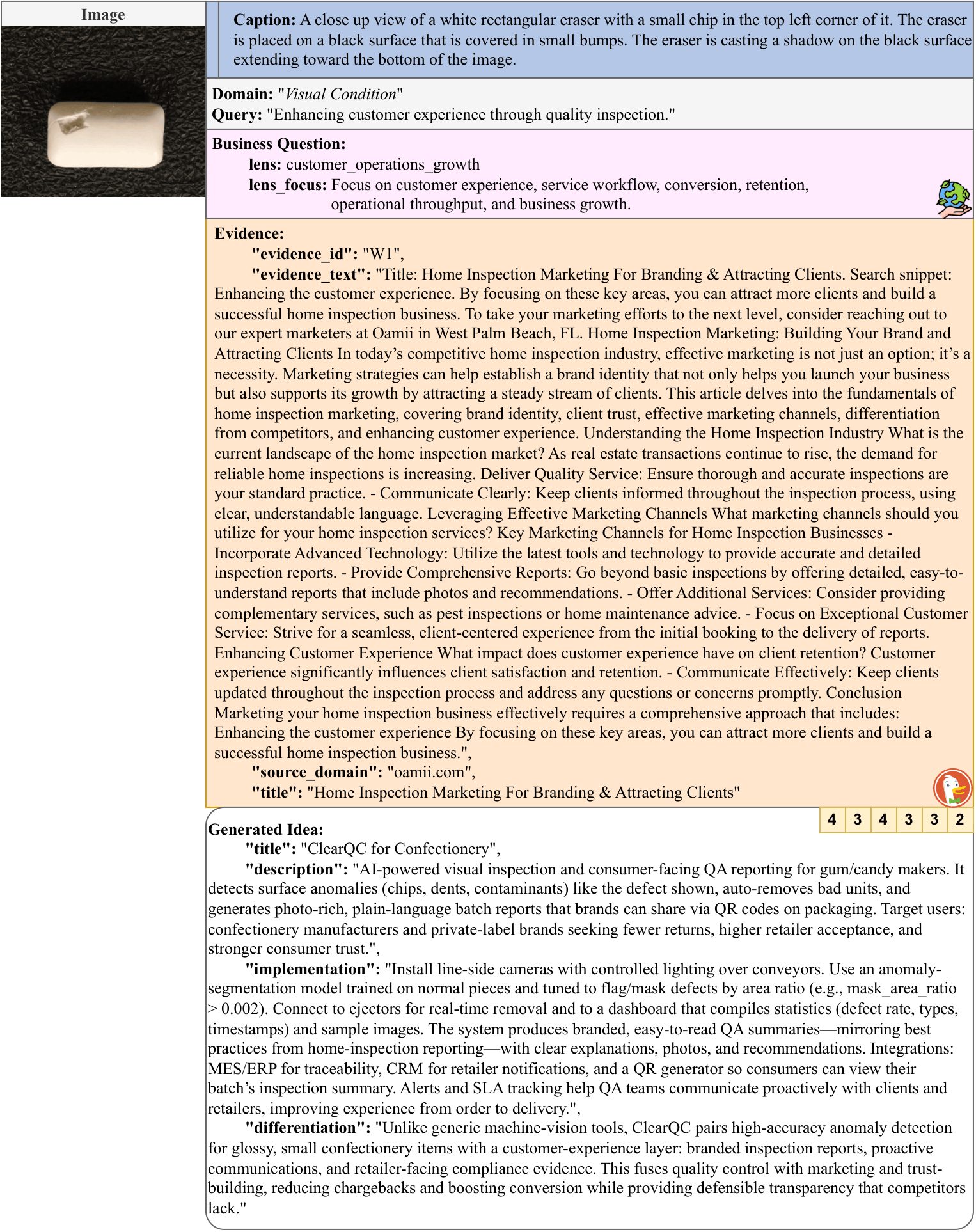
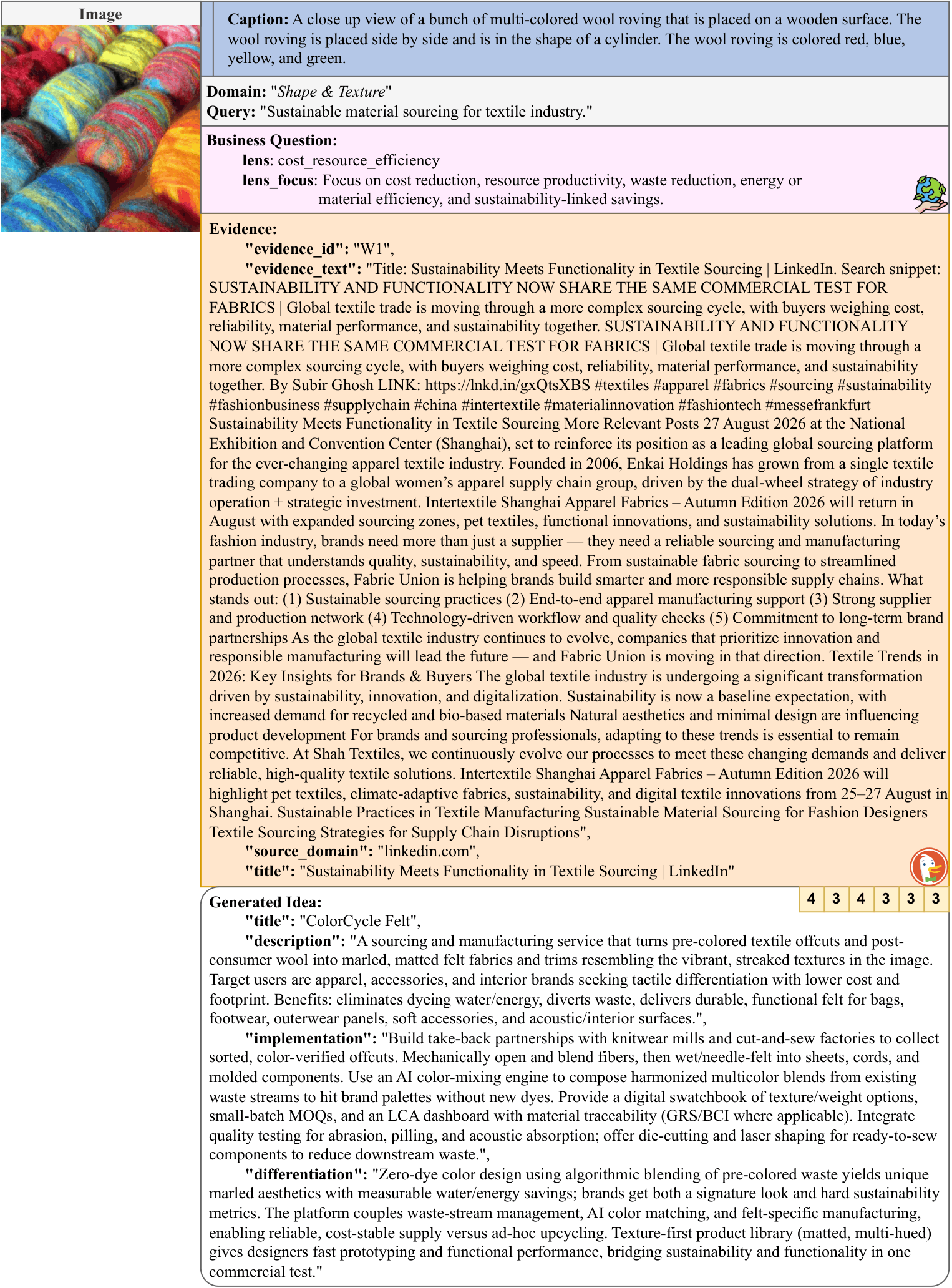
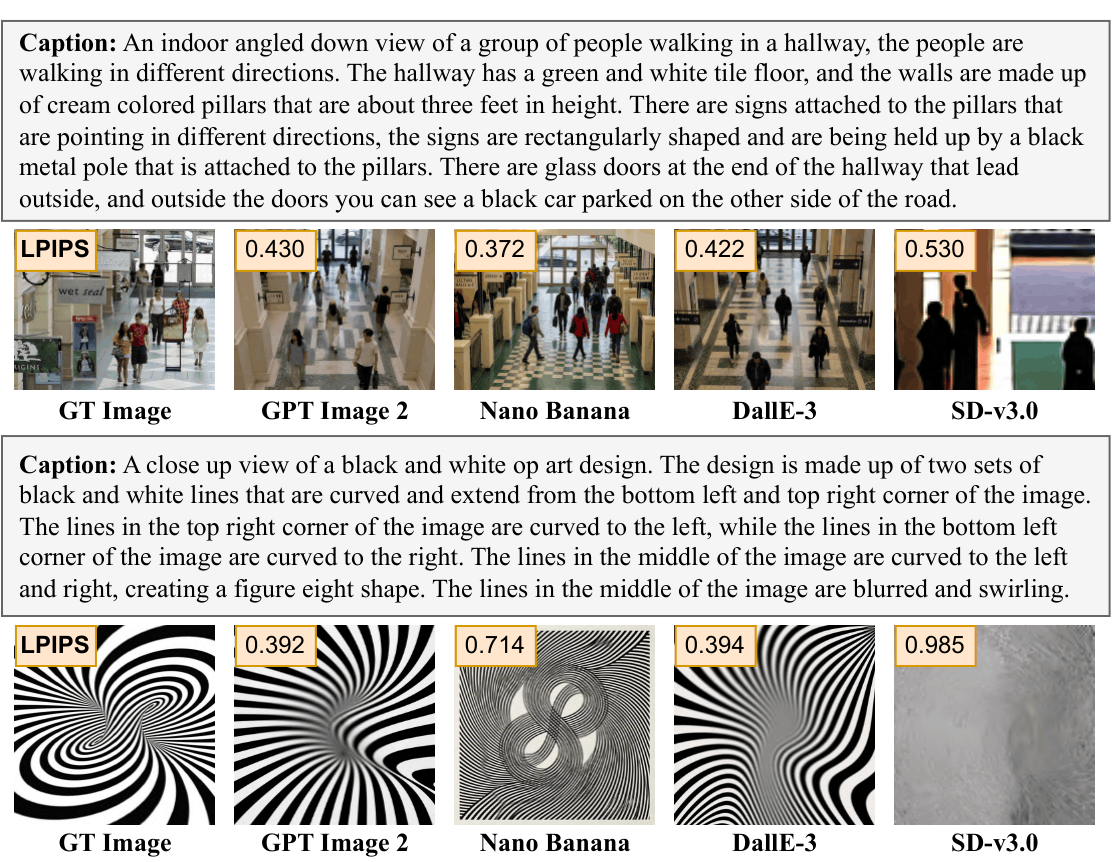
Existing business ideation pipelines are largely text-in, text-out systems. This assumption is restrictive because many real-world business opportunities depend on visual context: layouts, crowding, defects, material patterns, interface structure, and other details that captions often omit or flatten. MBA-Bench directly tests this gap by evaluating agents on image-grounded prompts rather than purely textual descriptions.

Cross-modal mismatch examples

Recommended image: Figure 7, showing cross-modal mismatch between visual details and text captions.

Key motivation. Captions provide useful summaries, but they can miss fine-grained visual cues that shape distinctive business opportunities. MBA therefore keeps the image in the loop and evaluates agents in a truly multimodal setting.

MBA-Bench

MBA-Bench is constructed from 2K image–caption pairs spanning six domains. For each sample, a three-step retrieval-augmented ideation protocol extracts visual queries, retrieves market evidence through web search, and synthesizes reference business ideas across three high-level question types: cost efficiency, technology, and user experience.

MBA-Bench Dataset Statistics
Domain Source Dataset Images Captions Business Questions Reference Ideas
General ADE20K 500 500 1,500 7,500
Spatial Layout RICO 350 350 1,050 5,250
Crowding COCO 350 350 1,050 5,250
Visual Condition VisA 350 350 1,050 5,250
Shape & Texture DTD 350 350 1,050 5,250
Technical Features DeepPCB 100 100 300 1,500
Total - 2,000 2,000 6,000 30,000

MBA Agents

MBA training pipeline

MBA trains task-specialized multimodal agents in two stages. First, an open-source MLLM is adapted with LoRA-based supervised fine-tuning on MBA-Bench question–idea pairs. Second, the SFT checkpoint is refined with GRPO using setting-specific ranking rewards. MBA-b targets a blind setting where only task-general creativity and feasibility rewards are available. MBA-k targets a known setting and additionally optimizes the six disclosed business-oriented criteria.

MBA-b: Blind Evaluation Setting

MBA-b assumes that the downstream evaluation rubric is not disclosed. It therefore optimizes two general objectives: creativity, which measures novelty relative to reference ideas, and feasibility, which grounds market relevance and factuality using MBA-Library.

MBA-k: Known Evaluation Setting

MBA-k assumes that the six evaluation metrics are known. In addition to creativity and feasibility, it optimizes specificity, technical validity, innovativeness, competitive advantage, need validity, and market size.

Results

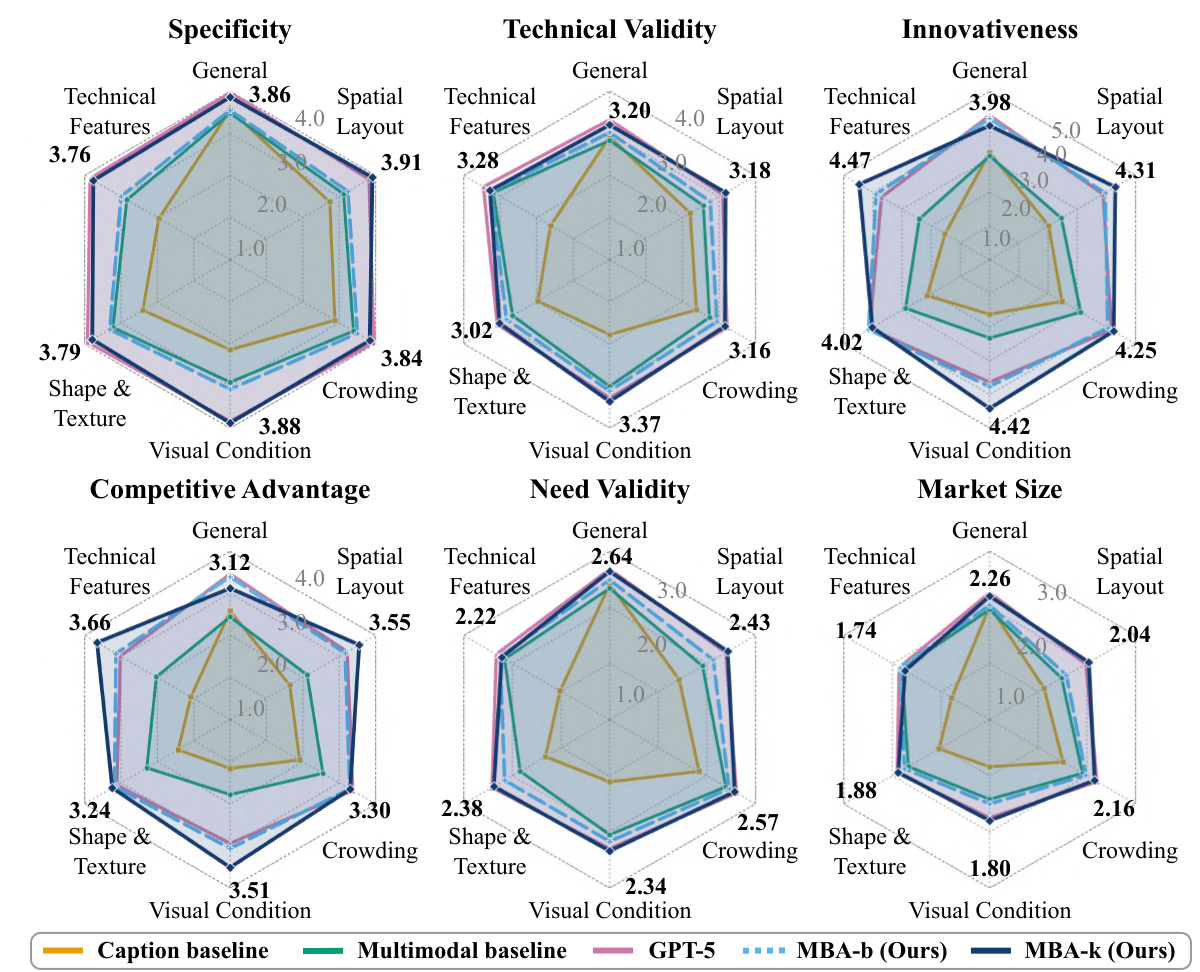
MBA-b and MBA-k outperform caption-only and multimodal baselines on MBA-Bench. MBA-b improves over caption and multimodal baselines by 53.6% and 16.9%, respectively, while MBA-k improves by 67.3% and 27.4%. The results indicate that multimodal training and setting-specific reward optimization can improve both creativity-related and feasibility-related aspects of business ideation.

Domain-wise benchmark results

Recommended image: Figure 2, showing domain-wise results across six business-oriented metrics.

Benchmark Results on MBA-Bench Test Set
Model Spec. ↑ T.V. ↑ Innov. ↑ C.A. ↑ N.V. ↑ M.S. ↑
Closed-source MLLMs
GPT-4o 3.51 3.04 3.04 2.79 2.27 2.05
GPT-5 mini 4.00 3.07 3.59 3.00 2.77 2.07
GPT-5 3.99 3.08 3.97 3.27 2.44 2.10
Claude-Sonnet-4.6 3.88 3.16 3.78 3.24 2.58 2.16
Gemini-3.1-pro-preview 4.00 3.04 3.98 3.01 2.97 2.35
Open-source MLLMs
LLaVA-OneVision-Qwen2-7B 3.39 2.99 3.17 2.91 2.33 2.15
InternVL2.5-8B 3.62 3.01 3.19 2.95 2.39 2.12
Qwen2.5-VL-7B-Instruct 3.60 3.06 3.15 2.62 2.32 1.94
MBA Agents
MBA-7B-SFT (Ours) 3.68 3.09 3.22 2.57 2.31 1.99
MBA-b-7B (Ours) 3.64 3.12 3.98 3.19 2.38 2.08
MBA-k-7B (Ours) 3.99 3.00 4.00 3.32 2.94 2.75

Spec.: Specificity; T.V.: Technical Validity; Innov.: Innovativeness; C.A.: Competitive Advantage; N.V.: Need Validity; M.S.: Market Size.

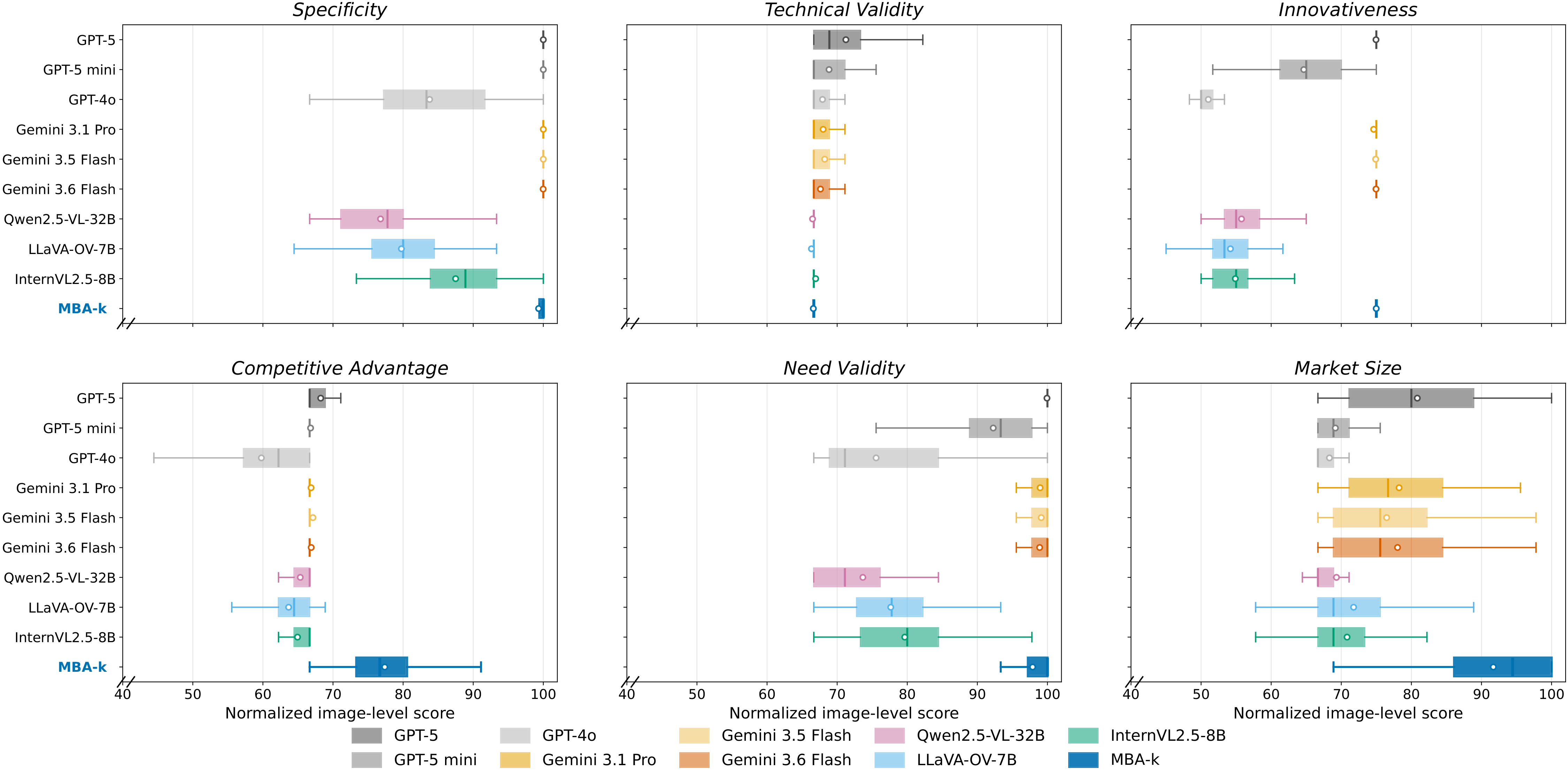
Normalized image-level score box plots across six evaluation metrics

Image-level score distributions across six business-oriented metrics. This box plot replaces the previous distribution figure.

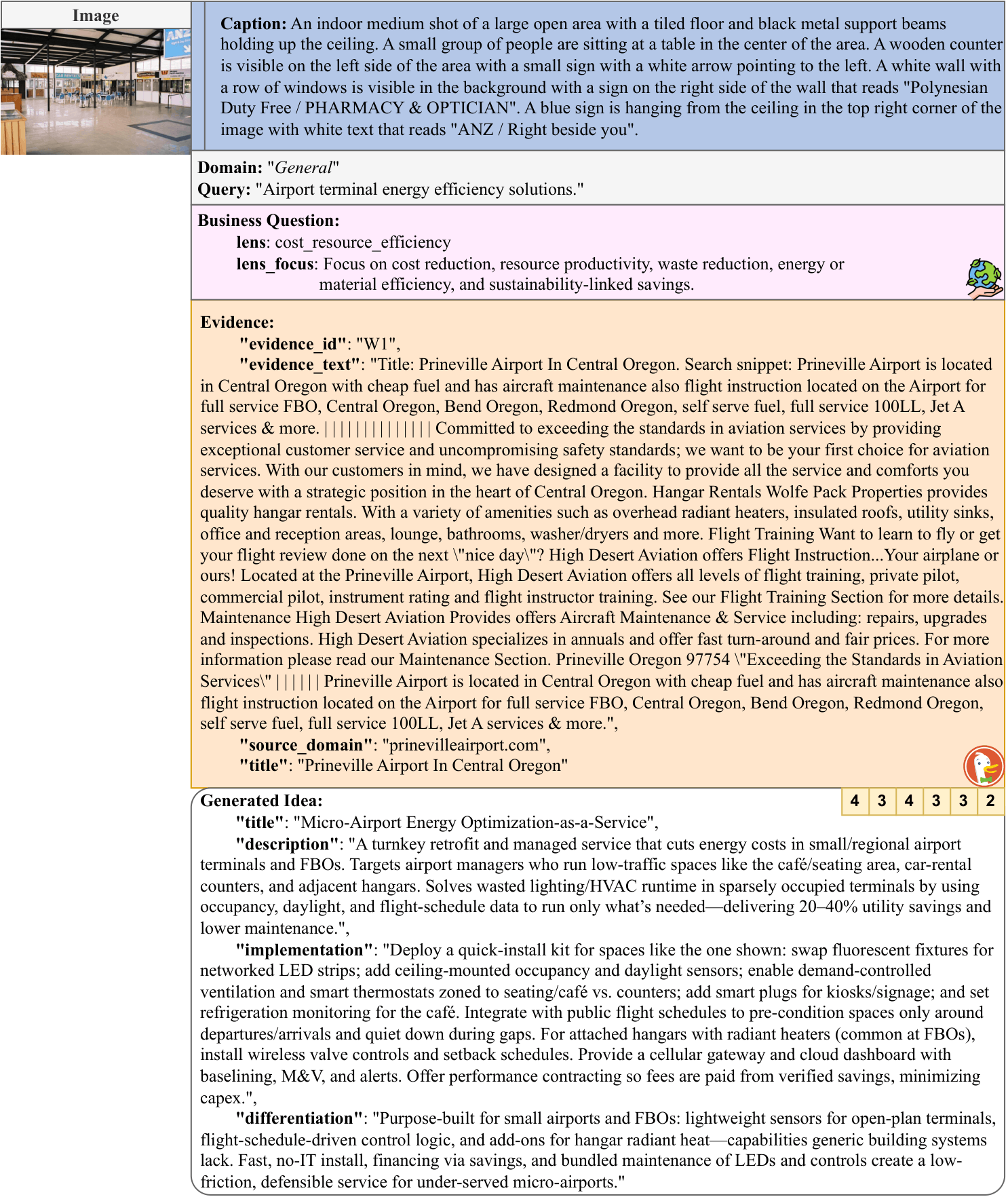
Representative MBA-Bench examples, one from each visual domain. Drag or swipe horizontally to browse.

Takeaways

Multimodal inputs matter

Caption-only baselines miss image-specific cues, while multimodal inputs provide a stronger foundation for ideation in domains such as crowding, visual condition, shape and texture, spatial layout, and technical features.

Reward design matters

SFT improves feasibility-related metrics, while GRPO with creativity and feasibility rewards improves originality and differentiation. MBA-k further benefits from optimizing the disclosed evaluation rubric.

BibTeX

TBD